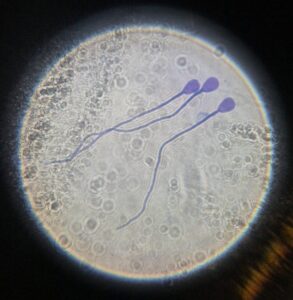
We check the quality and quantity of the semen with specialized equipment.
We do various tests and an ultrasound of the testicles and the prostate. If possible, we will then start appropriate therapy.
In the case of undescended testicles, we can perform a vasectomy under laparoscopy (just like in humans). In the case of unilateral cryptorchidism, we can thus maintain the coat quality and other benefits of the male hormones.
During an initial consultation we do a full health check-up of the bitch. In addition we take smears, check the uterus and ovaries via ultrasound and also do possible blood tests to check hormones.
40% of failed matings or inseminations are the result of poor timing. That is why we look beyond the 11th calendar day or signals such as behavior, vaginal discharge and tolerance reflex. With chilled, frozen or fresh semen of poor quality, it is crucial to know the exact time at which the mature eggs are present. We therefore estimate the ovulation time as precisely as possible to guarantee successful mating/insemination, but also to ensure that the further follow-up of pregnancy and delivery runs smoothly. We do this with the help of:
-
- Progesterone: the amount of sex hormone in the blood starts to rise before ovulation, remains high during pregnancy (or pseudopregnancy) and drops back to basal levels at delivery. With our Minividas device we can guarantee measurements with high reliability. The device is calibrated every two weeks. You can expect your result from us within an hour after blood collection. For patients who follow our fertility monitoring program, a progesterone test is also possible on Sundays and public holidays.
- Vaginal cytology: we use a swab to take a vaginal smear to examine under the microscope. We assess the keratinization of the vaginal cells, which increase together with the estrogen. This is useful information for monitoring the cycle, but can also help detect infections and some diseases.
- Ovarian ultrasound: an ultrasound of the ovaries helps to monitor the growth of the follicles, ovulation and the development of corpus luteum. We see ultrasound as an aid in cycle monitoring as you would have to do an ultrasound twice a day during the heat cycle to use this as the only method. It is however the best way to detect many abnormalities of the ovaries and uterus.
- Vaginoscopy: the vagina is examined with an endoscope under video guidance. The mucous membrane changes throughout the cycle. It expands and becomes moist as estrogen levels rise. Therefore, vaginoscopy can be used as a tool to determine the timing of mating, but the results are subjective as each animal is different. Vaginoscopy also helps visualize anatomical abnormalities (e.g. septum, occlusion, hymen) and symptoms of certain diseases (e.g. inflammation, trauma, tumors , …)
In case of reduced fertility, both the uterus and ovaries can be examined. This is how we detect cysts, growths, inflammations, deformities, etc.

With Laparoscopy (keyhole surgery) it is possible to visualize cysts, tumors, adhesions, etc. and to treat them where possible.
We check the quality and quantity of the semen with specialized equipment.

We do various tests and an ultrasound of the testicles and the prostate. If possible, we will then start appropriate therapy.
In the case of undescended testicles, we can perform a vasectomy under laparoscopy (just like in humans). In the case of unilateral cryptorchidism, we can thus maintain the coat quality and other benefits of the male hormones.
During an initial consultation we do a full health check-up of the bitch. In addition we take smears, check the uterus and ovaries via ultrasound and also do possible blood tests to check hormones.
40% of failed matings or inseminations are the result of poor timing. That is why we look beyond the 11th calendar day or signals such as behavior, vaginal discharge and tolerance reflex. With chilled, frozen or fresh semen of poor quality, it is crucial to know the exact time at which the mature eggs are present. We therefore estimate the ovulation time as precisely as possible to guarantee successful mating/insemination, but also to ensure that the further follow-up of pregnancy and delivery runs smoothly. We do this with the help of:
-
- Progesterone: the amount of sex hormone in the blood starts to rise before ovulation, remains high during pregnancy (or pseudopregnancy) and drops back to basal levels at delivery. With our Minividas device we can guarantee measurements with high reliability. The device is calibrated every two weeks. You can expect your result from us within an hour after blood collection. For patients who follow our fertility monitoring program, a progesterone test is also possible on Sundays and public holidays.
- Vaginal cytology: we use a swab to take a vaginal smear to examine under the microscope. We assess the keratinization of the vaginal cells, which increase together with the estrogen. This is useful information for monitoring the cycle, but can also help detect infections and some diseases.
- Ovarian ultrasound: an ultrasound of the ovaries helps to monitor the growth of the follicles, ovulation and the development of corpus luteum. We see ultrasound as an aid in cycle monitoring as you would have to do an ultrasound twice a day during the heat cycle to use this as the only method. It is however the best way to detect many abnormalities of the ovaries and uterus.
- Vaginoscopy: the vagina is examined with an endoscope under video guidance. The mucous membrane changes throughout the cycle. It expands and becomes moist as estrogen levels rise. Therefore, vaginoscopy can be used as a tool to determine the timing of mating, but the results are subjective as each animal is different. Vaginoscopy also helps visualize anatomical abnormalities (e.g. septum, occlusion, hymen) and symptoms of certain diseases (e.g. inflammation, trauma, tumors , …)
In case of reduced fertility, both the uterus and ovaries can be examined. This is how we detect cysts, growths, inflammations, deformities, etc.
With Laparoscopy (keyhole surgery) it is possible to visualize cysts, tumors, adhesions, etc. and to treat them where possible.